Buy Vending Machines

Start Your Own Vending Business

800-764-8245
  • Home
  • Vending Machines
  • Used Machines
  • Financing
  • Vending Blog
  • Videos
  • FAQ’s
  • Contact
  •  

CHANGES TO SCHOOL MEALS

Agriculture Secretary Perdue Says His Department Will Provide Greater Flexibility In Nutrition Requirements For School Meals

USDA Press Release

TAGS: U.S. Secretary of Agriculture, Sonny Perdue, Department of Agriculture, USDA school meal programs, Catoctin Elementary School, School Nutrition Employee Week, Pat Robert, Patricia Montague, School Nutrition Association

PRESS RELEASE

Source: USDA | Released May 2, 2017


Sonny Perdue moves to ‘make school meals great again.’ Local control of whole grains, sodium, milk to make meals healthful and appealing


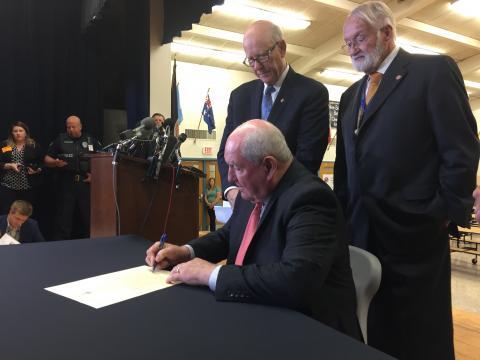
LEESBURG, VA, May 1, 2017 — U.S. Secretary of Agriculture Sonny Perdue today announced that the U.S. Department of Agriculture (USDA) will provide greater flexibility in nutrition requirements for school meal programs in order to make food choices both healthful and appealing to students. Perdue made the announcement during a visit to Catoctin Elementary School in Leesburg, VA, to mark School Nutrition Employee Week. Perdue signed a proclamation which begins the process of restoring local control of guidelines on whole grains, sodium, and milk. Perdue was joined by Sen. Pat Roberts (KS), Chairman of the Senate Committee on Agriculture, Nutrition and Forestry, and Patricia Montague, CEO of the School Nutrition Association.

“This announcement is the result of years of feedback from students, schools, and food service experts about the challenges they are facing in meeting the final regulations for school meals,” Perdue said. “If kids aren’t eating the food, and it’s ending up in the trash, they aren’t getting any nutrition — thus undermining the intent of the program.”

“I commend Secretary Perdue for taking this important step,” said Montague. “We have been wanting flexibility so that schools can serve meals that are both nutritious and palatable. We don’t want kids wasting their meals by throwing them away. Some of our schools are actually using that food waste as compost. That shouldn’t be happening.”

Sony Perdue, school lunch
PHOTO: Agriculture Secretary Sonny Perdue, joined by Sen. Pat Roberts (l.) and Loudoun County school board’s Tom Marshall, signs a proclamation.


Schools have been facing increasing fiscal burdens as they attempt to adhere to existing, stringent nutrition requirements. According to USDA figures, school food requirements cost school districts and states an additional $1.22 billion in fiscal year 2015. At the same time costs are going up, most states are reporting that they’ve seen a decrease in student participation in school lunches, as nation-wide about one million students choose not to have a school lunch each day. This impacts schools in two ways: The decline in school lunch participation means reduced revenue to schools while they simultaneously are encountering increased costs.

“I was talking to some folks in Washington about this, and they said that the current program is working. ‘How do you know?’ I asked. They said it’s because 99 percent of schools are at least partially compliant. Well, only in Washington can that be considered proof that the system is working as it was intended,” Perdue said. “A perfect example is in the south, where the schools want to serve grits. But the whole grain variety has little black flakes in it, and the kids won’t eat it. The school is compliant with the whole grain requirements, but no one is eating the grits. That doesn’t make any sense.”

The specific flexibilities are:

Whole grains:
» Schools are experiencing challenges in finding the full range of products they need and that their students enjoy in whole grain-rich form. They need continued flexibility in meeting the whole grain requirements for school meals.
» USDA will allow states to grant exemptions to schools experiencing hardship in serving 100 percent of grain products as whole-grain rich for School Year 2017-2018. USDA will take all necessary regulatory actions to implement a long-term solution.
Sodium:
» For School Years 2017-2018 through 2020, schools will not be required to meet Sodium Target 2. Instead, schools that meet Sodium Target 1 will be considered compliant.
» The time frame will provide schools and the school nutrition industry with the certainty and predictability they need to make appropriate plans for creating foods with the appropriate amount of sodium. During this period, USDA will take all necessary regulatory actions to implement a long-term solution.
» USDA will dedicate significant resources to providing technical assistance to schools as they continue to develop menus that are low in sodium and appealing to students.
Milk:
» Milk is a key component of school meals, meaning schools must have more options for students who select milk as part of their lunch or breakfast.
» Perdue will direct USDA to begin the regulatory process for schools to serve 1 percent flavored milk through the school meals programs. USDA will seek to publish an interim rule as soon as possible to effect the change in milk policy.

“I’ve got 14 grandchildren, and there is no way that I would propose something if I didn’t think it was good, healthful, and the right thing to do,” Perdue said. “And here’s the thing about local control: it means that this new flexibility will give schools and states the option of doing what we’re laying out here today. These are not mandates on schools.”

Perdue lauded the efforts of the nation’s food service staff in serving healthful, appealing meals and underscored USDA’s commitment to help them overcome any remaining challenges they face in meeting the nutrition standards.

“The hard work and dedication of the people who prepare nutritious meals for our children should serve as an example to all, and we will continue to support them,” Perdue said. “We also have a responsibility to our shareholders and our customers – the American taxpayers – to provide our school children with healthful and nutritious meals in the most efficient and cost effective way possible.”

For more information, please view a copy of Secretary Perdue’s proclamation (PDF, 123 KB).

USDA’s Food and Nutrition Service administers 15 nutrition assistance programs that include the National School Lunch Program, School Breakfast Program, Supplemental Nutrition Assistance Program (SNAP), Special Supplemental Nutrition Program for Women, Infants and Children (WIC), and the Summer Food Service Program. Together, these programs comprise America’s nutrition safety net. For more information, visit www.fns.usda.gov.


Information contained on this page is provided by the company via press release distributed by the company, organization, agency or other “source.” Vending Times Inc. and VendingTimes.com make no warranties or representations in connection therewith.


2017 NAMA SHOW INFO

FAQs for Attendees

What does “NAMA” stand for?
NAMA stands for the National Automatic Merchandising Association.
What does NAMA do?
NAMA is the national trade association of the food and refreshment vending, coffee service and foodservice management industries, including on-site, commissary, catering and micro markets. Our membership is comprised of service companies, equipment manufacturers and suppliers of products and services to operating service companies.
Where and when is the OneShow?
The 2017 NAMA OneShow will take place April 19-21, 2017 at The Venetian, 3355 S. Las Vegas Blvd., Las Vegas, NV 89109.
Is there a membership to your association and how much is it?
Yes, there are different categories of membership. Learn more about NAMA membership or contact NAMA Membership at 888-337-8363 or members@namanow.org.
Do you have to be a member or meet any criteria to attend the OneShow?
You do not need to be a member of NAMA to attend the OneShow, although pricing is considerably lower for members. Anyone involved in the coffee service, micro market and vending industries are welcome to attend the OneShow.
How much does it cost to attend the OneShow?
There are different price levels. Visit the registration page for pricing information.

Is the registration fee the same for my spouse?
Yes, the pricing will be the same for spouses as it is for the member/non-member attendee.
Can children attend?
Yes, children are welcome on the show floor. Children under the age of 18 can attend the OneShow free of charge. Please note: Strollers are not allowed on the show floor.
Does my personal care assistant have to pay for a registration badge?
No, if you have a disability and require a personal care assistant they will receive a complimentary visitor badge when you register together.
Can students attend the OneShow?
Yes, we welcome all hospitality students to the OneShow. Just show your student I.D. at registration, and you may attend free of charge.
Are educational sessions included in my registration fee?
All of our exciting keynote speakers and many other educational programs are included, unless otherwise noted.
What is the attire?
The recommended attire is business or business-casual

Does the Vending Machine have to be ADA Compliant?

The revised Americans with Disabilities Act (ADA) impacts vendors whose equipment does not meet the “upside down rule”.  The “upside down rule” basically asks if the building where your machine is located was to be turned upside down, would your vending machine remain fixed or would your machine fall?  If your equipment falls, then you are exempt from the new ADA rules. However, ADA law does apply to you if you use the building’s plumbing or wiring.  This clause does not apply to power cords or electricity received from your location.  As long as your vending machine is not bolted or secured to the building and your machine isn’t hard wired into the electric or plumed into the building then new ADA rules do not apply to you.

If, however, your vending machine is bolted, here’s the scope of items that are regulated: depository, vending machine, product and change machine.  All components must meet the new standards. Vending machine product must be delivered at a minimum height of 15″ to all users.  All buttons or switches must be within reach range.

Stand-alone machines are considered to be like furniture as long as they’re not bolted to the wall or floor and doesn’t use the building’s wiring or plumbing.

The Department of Justice regulates and enforces the ADA.   If you bolt your machine to the building, and don’t comply with regulations, the cost can be great!  If you have multiple machines at one location and either item is bolted, one of those machines has to be ADA compliant.

Even though this isn’t a requirement, it is good practice to implement, if your machine isn’t bolted. Take a look at the diagram used in this article.  There must be at least 30” of space in front of the machine and 48” of space when parallel to the vending machine.

If you have questions, an ADA Specialist is available to speak with you via telephone at (800) 514-0301 or (800) 514-0383 (TTY)
ADA_Regulations

How to display nutritional information on the vending machine


Healthy vending is not a crave that is going away. Society today is striving to make healthier eating habits and that includes what they buy from vending machines.  People want to know what they are eating, and laws are being enacted requiring companies to display nutritional facts on all food being sold.  The vending industry is no exception.  We have been the poster child for unhealthy food and drinks, but we can change this stereotype.  I have blogged about Fit Pick in past blogs, and this is still an excellent program for promoting healthy snacks in vending machines.  In fact, it offers over 500 products which can be labeled as “healthy” and over 175 government agencies and 100 schools have adopted it to help promote healthy vending. (http://www.vendingtimes.com)

I’d like to show you one more tool that will be very helpful in promoting healthy vending.  Last month I attended the NAMA One Show in Las Vegas where all the major vending manufacturers showcased their latest products and technologies. I was amazed by the products on the market today- especially the many products that enabled additional nutritional value information to be displayed on the vending machine. There are a number of companies that are offering this technology including VendScreen, AirVend, Vendors Exchange, and others.

Some of these devices are a small 6” screen that can be added to a vending machine to display ads, promotions, and display the nutritional information.  Some products are even combined with the credit card reader and can be used to track real time product data, and provide pre-kitting information back to the office.  The companies that sell the touch screens have also provided a database of the most popular foods and beverages which can be uploaded with the nutritional value information already built in.  If your product isn’t in their inventory, then you can upload your own nutritional values into the system.

At Piranha Vending, we pride ourselves in keeping our prices low and that means finding products that are affordable. We won’t be discussing a topic here unless it can be sold affordably in our on-line store.  We are now offering the Air Vend on our vending machines which will provide the nutritional value information and also process credit cards.

Some folks say that this is a waste of time and money and that their customers don’t care about nutritional information on their candy bars and sodas.  Although most of their customers don’t care about the nutritional values, there is a growing percentage of customers who do care and they are not buying from our vending machines because they have the perception that it is all “junk food”. By providing nutritional facts on all the products sold in the vending machine, you are proving to that potential customer that the snack is indeed healthy and hopefully you will convert them as a customer.  The demand is here, the technology is here, and it’s actually quite affordable too.

How do YOU start a Healthy Vending Business?

If you’re looking to get on board with the healthy vending revolution that’s taken America by storm, you’ll need the right vending machine, appropriate product, and the best locations, without breaking the bank! We’re here to tell you exactly how you can do this without being locked into a franchise such as Human Healthy Vending.

Whether you’re vending traditional snacks, drinks, healthy snacks, or a combination, you’ll need a vending machine that is appropriate for your product and eye-catching to draw in customers. Many healthy vending franchises say they’re giving you a great deal when they offer vending operators start-up packages that include the machine, product, locations, tutorials, etc. for exorbitant prices. Such franchises include Human Healthy Vending, Healthy You, Fresh Healthy Vending, Naturals 2 Go, and others. Don’t be fooled! You can buy a vending machine new or used with a warranty for less than half of the cost that the healthy vending franchises charge! When buying a machine, keep in mind that a Healthy Wrap or some other healthy design/decal will identify your vending machine as a healthy option for customers and attract more sales.

Many healthy vending operators who are just getting into the business are under the impression that they have to special-order product or purchase online to offer their customers the healthier options they’re looking for. Many of the franchises like HUMAN Healthy Vending and Fresh Healthy Vending are spreading these lies but it simply is not true! healthy-vending-expensiveYou can find most healthy vending products locally. Check out our blog post on healthy product ideas. Buying in bulk from places like Sam’s Club or Costco can save you hundreds when re-stocking your machine and you can then pass those savings on to your customers. Additionally it is more convenient to be able to buy them on demand as you are serving your route instead of waiting days for the product to arrive.

Once you have the perfect healthy vending machine with all the best products stocked in it, you need to find the most profitable locations for your machines. Check out the DVS Blog for tips on finding and securing some of the best locations; remember that you don’t have to hire a locator or offer high commissions to get your machine in the hottest spots. You can usually sell a prospective customer on your machine, product, and services alone, without the need to offer a commission.   However, if you don’t have time to locate the machines yourself, there are many great companies out there who can help you find good locations for around $400- 500. Check out our resources page for more information.

Lastly you will need the proper licensing from your state, county and city where you are doing business. Don’t get overwhelmed by the bureaucracy though. With a simple google search you should be able to find out what forms need to be filed and licenses obtained in your local area. The vending business is one of the easiest small businesses to get into and the Return on Investment (ROI) is typically less than a year if you do it right by buying an affordable machine and securing good locations.  Give us a call as we are here to help you do just that.  If you have additional tips and feedback please share them with us.

  • « Previous Page
  • 1
  • 2
  • 3
  • 4
  • 5
  • Next Page »
  • New Vending Machines
  • Pre-owned Vending Machines

Contact Us

Piranha, LLC
50601 Central Industrial Drive
Shelby Township, Michigan 48315, USA

Email: piranhamfg@gmail.com

Phone: 800-764-8245 * 586-997-1212

Featured Posts

HIGH FRUCTOSE AND OPIOIDS ADDITION POSSIBILITY?

Diets high in high fructose corn syrup may indirectly contribute to opioid dependence, according to research presented this week at Neuroscience 2017, the annual meeting of the Society for Neuroscience. Previous research has shown that high fructose corn syrup (HFCS) impacts the brain in a way similar to addictive drugs. It triggers a “reward response” […]

Follow Us

Copyright © 2026 Piranha, LLC

Privacy Policy | Terms & Conditions | Refunds & Return Policy