Buy Vending Machines

Start Your Own Vending Business

800-764-8245
  • Home
  • Vending Machines
  • Used Machines
  • Financing
  • Vending Blog
  • Videos
  • FAQ’s
  • Contact
  •  

CHANGES TO SCHOOL MEALS

Agriculture Secretary Perdue Says His Department Will Provide Greater Flexibility In Nutrition Requirements For School Meals

USDA Press Release

TAGS: U.S. Secretary of Agriculture, Sonny Perdue, Department of Agriculture, USDA school meal programs, Catoctin Elementary School, School Nutrition Employee Week, Pat Robert, Patricia Montague, School Nutrition Association

PRESS RELEASE

Source: USDA | Released May 2, 2017


Sonny Perdue moves to ‘make school meals great again.’ Local control of whole grains, sodium, milk to make meals healthful and appealing


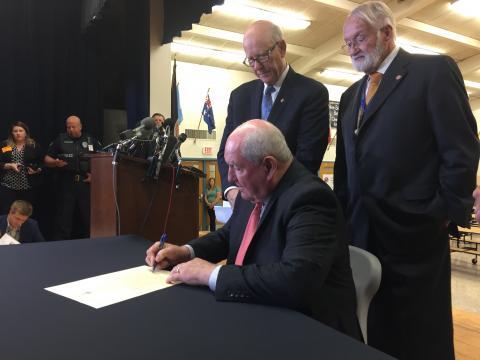
LEESBURG, VA, May 1, 2017 — U.S. Secretary of Agriculture Sonny Perdue today announced that the U.S. Department of Agriculture (USDA) will provide greater flexibility in nutrition requirements for school meal programs in order to make food choices both healthful and appealing to students. Perdue made the announcement during a visit to Catoctin Elementary School in Leesburg, VA, to mark School Nutrition Employee Week. Perdue signed a proclamation which begins the process of restoring local control of guidelines on whole grains, sodium, and milk. Perdue was joined by Sen. Pat Roberts (KS), Chairman of the Senate Committee on Agriculture, Nutrition and Forestry, and Patricia Montague, CEO of the School Nutrition Association.

“This announcement is the result of years of feedback from students, schools, and food service experts about the challenges they are facing in meeting the final regulations for school meals,” Perdue said. “If kids aren’t eating the food, and it’s ending up in the trash, they aren’t getting any nutrition — thus undermining the intent of the program.”

“I commend Secretary Perdue for taking this important step,” said Montague. “We have been wanting flexibility so that schools can serve meals that are both nutritious and palatable. We don’t want kids wasting their meals by throwing them away. Some of our schools are actually using that food waste as compost. That shouldn’t be happening.”

Sony Perdue, school lunch
PHOTO: Agriculture Secretary Sonny Perdue, joined by Sen. Pat Roberts (l.) and Loudoun County school board’s Tom Marshall, signs a proclamation.


Schools have been facing increasing fiscal burdens as they attempt to adhere to existing, stringent nutrition requirements. According to USDA figures, school food requirements cost school districts and states an additional $1.22 billion in fiscal year 2015. At the same time costs are going up, most states are reporting that they’ve seen a decrease in student participation in school lunches, as nation-wide about one million students choose not to have a school lunch each day. This impacts schools in two ways: The decline in school lunch participation means reduced revenue to schools while they simultaneously are encountering increased costs.

“I was talking to some folks in Washington about this, and they said that the current program is working. ‘How do you know?’ I asked. They said it’s because 99 percent of schools are at least partially compliant. Well, only in Washington can that be considered proof that the system is working as it was intended,” Perdue said. “A perfect example is in the south, where the schools want to serve grits. But the whole grain variety has little black flakes in it, and the kids won’t eat it. The school is compliant with the whole grain requirements, but no one is eating the grits. That doesn’t make any sense.”

The specific flexibilities are:

Whole grains:
» Schools are experiencing challenges in finding the full range of products they need and that their students enjoy in whole grain-rich form. They need continued flexibility in meeting the whole grain requirements for school meals.
» USDA will allow states to grant exemptions to schools experiencing hardship in serving 100 percent of grain products as whole-grain rich for School Year 2017-2018. USDA will take all necessary regulatory actions to implement a long-term solution.
Sodium:
» For School Years 2017-2018 through 2020, schools will not be required to meet Sodium Target 2. Instead, schools that meet Sodium Target 1 will be considered compliant.
» The time frame will provide schools and the school nutrition industry with the certainty and predictability they need to make appropriate plans for creating foods with the appropriate amount of sodium. During this period, USDA will take all necessary regulatory actions to implement a long-term solution.
» USDA will dedicate significant resources to providing technical assistance to schools as they continue to develop menus that are low in sodium and appealing to students.
Milk:
» Milk is a key component of school meals, meaning schools must have more options for students who select milk as part of their lunch or breakfast.
» Perdue will direct USDA to begin the regulatory process for schools to serve 1 percent flavored milk through the school meals programs. USDA will seek to publish an interim rule as soon as possible to effect the change in milk policy.

“I’ve got 14 grandchildren, and there is no way that I would propose something if I didn’t think it was good, healthful, and the right thing to do,” Perdue said. “And here’s the thing about local control: it means that this new flexibility will give schools and states the option of doing what we’re laying out here today. These are not mandates on schools.”

Perdue lauded the efforts of the nation’s food service staff in serving healthful, appealing meals and underscored USDA’s commitment to help them overcome any remaining challenges they face in meeting the nutrition standards.

“The hard work and dedication of the people who prepare nutritious meals for our children should serve as an example to all, and we will continue to support them,” Perdue said. “We also have a responsibility to our shareholders and our customers – the American taxpayers – to provide our school children with healthful and nutritious meals in the most efficient and cost effective way possible.”

For more information, please view a copy of Secretary Perdue’s proclamation (PDF, 123 KB).

USDA’s Food and Nutrition Service administers 15 nutrition assistance programs that include the National School Lunch Program, School Breakfast Program, Supplemental Nutrition Assistance Program (SNAP), Special Supplemental Nutrition Program for Women, Infants and Children (WIC), and the Summer Food Service Program. Together, these programs comprise America’s nutrition safety net. For more information, visit www.fns.usda.gov.


Information contained on this page is provided by the company via press release distributed by the company, organization, agency or other “source.” Vending Times Inc. and VendingTimes.com make no warranties or representations in connection therewith.


How to display nutritional information on the vending machine


Healthy vending is not a crave that is going away. Society today is striving to make healthier eating habits and that includes what they buy from vending machines.  People want to know what they are eating, and laws are being enacted requiring companies to display nutritional facts on all food being sold.  The vending industry is no exception.  We have been the poster child for unhealthy food and drinks, but we can change this stereotype.  I have blogged about Fit Pick in past blogs, and this is still an excellent program for promoting healthy snacks in vending machines.  In fact, it offers over 500 products which can be labeled as “healthy” and over 175 government agencies and 100 schools have adopted it to help promote healthy vending. (http://www.vendingtimes.com)

I’d like to show you one more tool that will be very helpful in promoting healthy vending.  Last month I attended the NAMA One Show in Las Vegas where all the major vending manufacturers showcased their latest products and technologies. I was amazed by the products on the market today- especially the many products that enabled additional nutritional value information to be displayed on the vending machine. There are a number of companies that are offering this technology including VendScreen, AirVend, Vendors Exchange, and others.

Some of these devices are a small 6” screen that can be added to a vending machine to display ads, promotions, and display the nutritional information.  Some products are even combined with the credit card reader and can be used to track real time product data, and provide pre-kitting information back to the office.  The companies that sell the touch screens have also provided a database of the most popular foods and beverages which can be uploaded with the nutritional value information already built in.  If your product isn’t in their inventory, then you can upload your own nutritional values into the system.

At Piranha Vending, we pride ourselves in keeping our prices low and that means finding products that are affordable. We won’t be discussing a topic here unless it can be sold affordably in our on-line store.  We are now offering the Air Vend on our vending machines which will provide the nutritional value information and also process credit cards.

Some folks say that this is a waste of time and money and that their customers don’t care about nutritional information on their candy bars and sodas.  Although most of their customers don’t care about the nutritional values, there is a growing percentage of customers who do care and they are not buying from our vending machines because they have the perception that it is all “junk food”. By providing nutritional facts on all the products sold in the vending machine, you are proving to that potential customer that the snack is indeed healthy and hopefully you will convert them as a customer.  The demand is here, the technology is here, and it’s actually quite affordable too.

When should you buy USED Vending Machines


The vending machine business offers entrepreneurs the option to choose between new and used machines. While there are obvious advantages of new machines (including appearance and access to the latest features), there are situations when used models offer a reasonable compromise. Here are times when used vending machines for sale make sense.

Cash Flow Shortages

Whether you are just beginning your vending business or have several machines in operation, every entrepreneur will face cash shortages in the course of a career. Used vending machines give you the opportunity to earn more from sales without having to invest in a brand-new machine. Before committing to a used model, do the research to make sure it is right for the location.

Maintaining Independence

If you are forced to bring in a partner to pay for a new vending machine, you are relinquishing some of your independence as a business owner. Some entrepreneurs dislike this arrangement because it limits your earning potential in the long run. Choosing used vending machines allows you to maintain complete control of the business.

Learning the Trade

Another reason used vending machines are attractive is how it allows you to learn the business with a smaller investment. Depending on the condition and model, an entrepreneur may be able to pay 25-40% less for a used machine than you would buying new. Though a new machine may appeal to more consumers, the opportunity to learn the business offers added value especially for new buyers.

Less Risk

When you have several businesses going at once, you’ll want to keep the risk minimal in the vending industry. Used vending machines allow you to enter the arena with less risk than you would with a new machine. If you want to resell your machine later, you can offer it at a price that allows you to recoup some of the investment.

How to increase your Vending Revenue

Whether your vending machine business is a success so far or otherwise, there’s always room for improvement. In this article, we offer some pointers in increasing the revenue generated by your vending machines.

  1. Monitor market trends

  2. Part of being successful in this business involves regularly monitoring what’s going on in the general marketplace. Go around town and take a look at some of your competitors. What type of items have they focused on? Are they drawing in customers? One recent trend to watch is the growth in popularity of “healthy” foods being sold in vending machines. If your candy sales are falling you might want to consider selling healthy snacks instead!

  3. Review your locations

  4. The vending machine business has the reputation of being “hands-off” – meaning that revenue is generated like clockwork after you’ve set up your machines. While this is partly true, you do need to keep an eye on how each machine is doing. Which area, if more than one, is progressing and which are not? If a particular machine is consistently faring badly then it is very important to find the cause of the problem and resolve it as soon as possible. You may find that moving locations will considerably raise product sales.

  5. Replenish product stocks in your machines

  6. Good stock management is vital for both maintaining and increasing revenues. If your machines are constantly out of stock you are leaving money on the table. Customers will tire of using your machines and may end up going elsewhere.

  7. Keep your machines in good condition

    For a customer, there is little more annoying than having money disappear inside a vending machine. Complaints can be a major headache for you and your employees. Instead, keep ahead of potential problems by servicing your vending machines on a regular basis. Your reputation depends upon it.

New USDA School Regulations

And How It Affects Your Vending Machine… 

In an effort to reduce the percentage of childhood obesity in the United States, the federal government has elected to alter the rules and regulations put forth by the US Department of Agriculture for snack and drink vending machines. These guidelines are being put into place in order to safeguard the health and well-being of future generations. For most people, this revolution won’t change anything. However, aside from nutrition coordinators and schoolchildren, there is a small minority who will certainly feel the impact of new procedures.

Vending machines are in the halls of schools all over the country. Behind those machines are vending machine proprietors and business owners whose livelihood depends on what products are in their machines, and the demand from consumers to purchase those products. Knowing the latest nutritional information and restrictions is essential for these entrepreneurs to succeed in their business and, with that in mind, here is a list of the newest facts and regulations issued by the USDA:

All Foods

Must be “whole grain-rich” products; or have a fruit, vegetable, dairy, or protein as their first ingredient; be a combination food that contains at least 1/4 cup of fruit and/or vegetable; or contain 10 percent of the daily value of one of the nutrients of public health concern in the 2010 Dietary Guidelines for Americans (calcium, potassium, vitamin D, or dietary fiber.)

Limits Per Serving

Calories: Snack: 200; Entrée: 350
Sodium: Snack: Less than 230 mg.; Entrée: 480 mg.
Fat: Snack: 35% of calories; Entrée: Less than 10% of calories; Trans fat: zero grams
Sugar: 35% of weight from total sugars in foods

NOTE: Beginning July 1, 2016, foods may not qualify using the 10% daily-value criteria, and snack items must contain no more than 200 mg. sodium per item.

Beverages

Juice: 100% fruit juice or vegetable juice with no added sweeteners
Milk: Unflavored, low-fat, or flavored low-fat milk; milk alternatives are allowed.
Water: No restrictions on plain water (with or without carbonation)

So What’s In and What’s Out?
Here are a few examples…


What’s In

What’s Out

Light Popcorn Chocolate Sandwich Cookie
Granola Bar Chocolate Bar
Flavored Water Soda Pop
Baked Potato Chips Candy
Trail Mix Snack Cakes
Dried Fruits Cookies
Fruit Cups Pretzels
Yogurt Ice Cream
Diet Sodas High Calorie Sodas
Diet Sports Drinks High Calorie Sports Drinks

When determining what merchandise to stock in a machine, keep a few key things in mind; under the new rules, most food sold in school will now be subject to fat, calorie, sugar and sodium limits. Snack foods will have to be less than 200 calories and have some nutritional value instead of being mostly empty calories. By respecting these new directives, a vendor is choosing to be a part of the cause and is helping reduce the consequences of childhood obesity, along with ensuring a secure, long-standing enterprise for future years to come.

To learn more about healthy vending options, visit Piranhavending.com we are always striving to offer the best service and satisfaction to our customers.

  • « Previous Page
  • 1
  • 2
  • 3
  • 4
  • 5
  • Next Page »
  • New Vending Machines
  • Pre-owned Vending Machines

Contact Us

Piranha, LLC
50601 Central Industrial Drive
Shelby Township, Michigan 48315, USA

Email: piranhamfg@gmail.com

Phone: 800-764-8245 * 586-997-1212

Featured Posts

HIGH FRUCTOSE AND OPIOIDS ADDITION POSSIBILITY?

Diets high in high fructose corn syrup may indirectly contribute to opioid dependence, according to research presented this week at Neuroscience 2017, the annual meeting of the Society for Neuroscience. Previous research has shown that high fructose corn syrup (HFCS) impacts the brain in a way similar to addictive drugs. It triggers a “reward response” […]

Follow Us

Copyright © 2026 Piranha, LLC

Privacy Policy | Terms & Conditions | Refunds & Return Policy